
October 7, 2025
By Andrew Guckes as published in Philadelphia Jewish Exponent
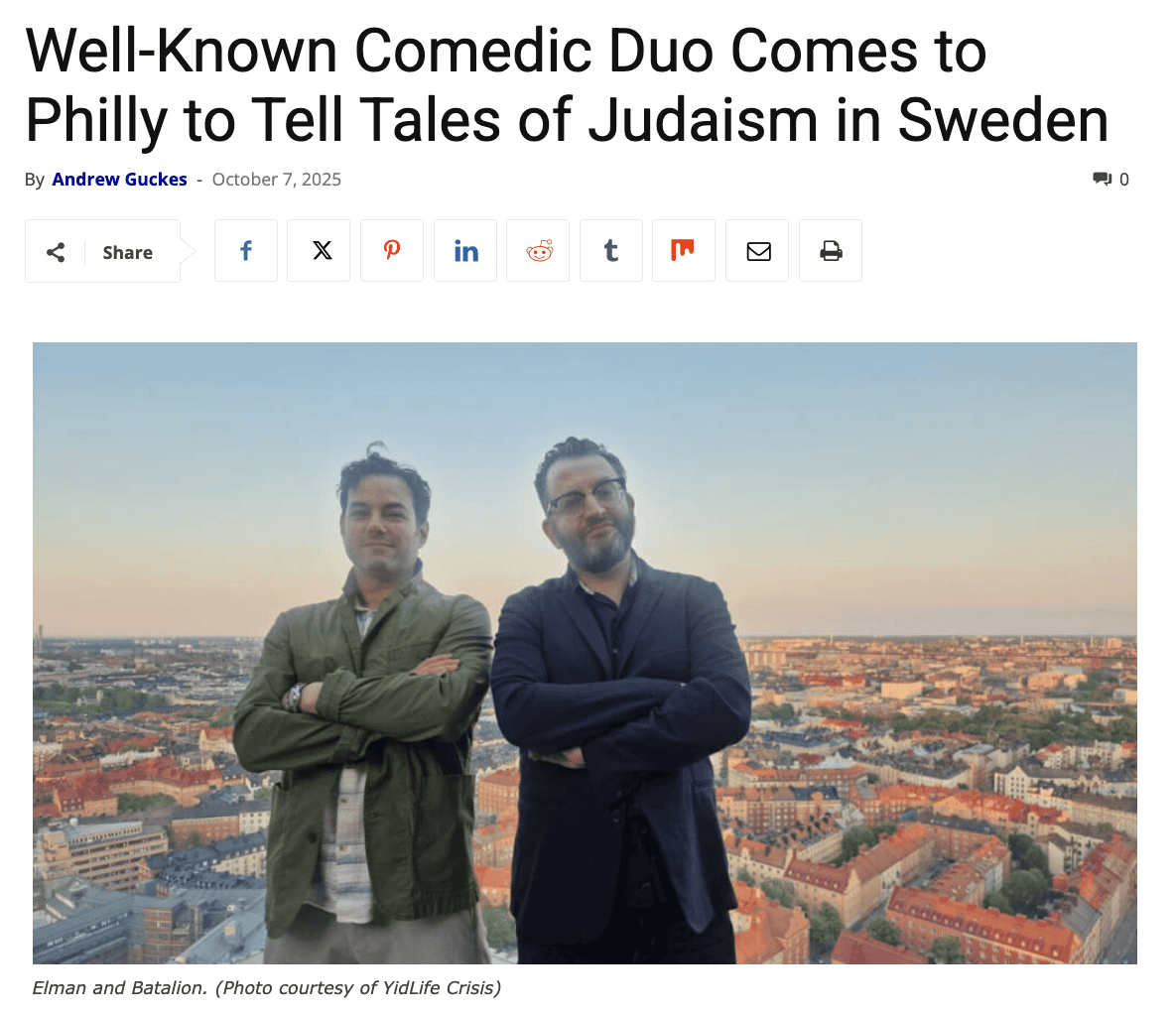
What do you know about Sweden?
That it’s the home of IKEA? That it’s cold? That it has good meatballs?
Many Americans know some of these facts and maybe a couple of others. Few, however, know that the Nordic country has a small but mighty Jewish community and that the country has officially designated Yiddish as a protected language.
So, why does this matter?
In their live show based on their documentary “Swedishkayt: YidLife Crisis in Stockholm,” Jewish entertainers with acting, writing, directing and producing credits Eli Batalion and Jamie Elman explore this question in the signature comedic style that made their Yiddish sitcom “YidLife Crisis” an international hit.
On Oct. 30, the duo will bring this live show to the Weitzman National Museum of American Jewish History in Philadelphia for a night of learning, laughs and surprises as part of a tour that stretches from Vancouver to Hong Kong.
This all started in 2019, when a previous documentary that the two friends from Montreal made got them a call from the Scandinavian nation.
“We got this crazy call from Sweden that they wanted us to perform, and we didn’t believe them, because obviously there are no Jews in Sweden,” Batalion said. “Long story short, there are Jews there, and Yiddish is a protected language in Sweden, which is why they were calling in the first place. So, we ended up making this documentary together with SVT (Swedish public television), and the rest is Jewish-Swedish history.”
Elman said that there was so much to learn about the Jewish community of Sweden, which resembles that of others in the diaspora in some ways but is unique, too. He referenced Jewish identity as it relates to a Swedish cultural custom as an example of a dynamic that we wouldn’t consider as North Americans.
“There’s a certain character to the Swedish people we talked about in the movie called the ‘Law of Jante,’ which is an unwritten social rule about how we should behave in society and not take up too much room and be respectful and not too loud,” Elman said. “How do you square that with being Jewish? Generally, we can get pretty loud, especially in North America … so [it was] very interesting to learn about how the Swedes approach Jewishness.”
Yiddish has been a protected language in Sweden since 1999. With that comes some interesting facts: Harry Potter books in Yiddish are published in Sweden. Swedes can file their taxes in Yiddish. Government business can be conducted in the language, too.
“Since this government-protected legislation kicked in, just the sheer creative artistic output of Yiddish is remarkable,” Elman said.
As for their own creative artistic output, Batalion and Elman said that they are excited to bring to the stage an event that is much more than just a film screening. The show begins with an extended comedic introduction, details of which are best saved as a surprise for those who attend. After that, they will show the movie, before coming back out to play some music in what Elman described as “Abba in Yiddish.”
“The whole experience is basically an evening of celebrating Yiddish and Yiddish pride and Jewish culture in the diaspora — the global Jewish community, Jewish comedy and music, and hopefully we will send everyone out with big smiles on their faces and feeling good about Jewish joy,” Elman said. “Something that we could all probably use a bit more of these days.”
Batalion said that the duo was thrilled to uncover what they believe is an underreported story, and that they are excited to bring their findings to area stages.
“We thought it was one of the best secrets in the world, and we wanted to spoil that secret for everyone,” Batalion said.